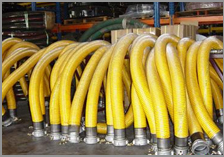

Most transfer hoses don’t fail in one dramatic moment. They wear out slowly. A cover cracks here, a section stiffens there, and a crew member starts taking the long way round a heavy line because dragging it hurts their back. By the time the problem gets a proper look, the hose may already be putting product, people and schedules at risk. A durable composite hose is one option plants weigh when that slow decline starts to show, so it helps to know what to look for before a small fault becomes a costly one.
The signs below come from everyday use in loading bays, jetties and process areas. You may spot one or two of them in your own plant. You may spot five. Either way, each one is a fair reason to ask whether a durable composite hose would serve your transfer lines better than what you run today.
1. Your Crew Struggles to Handle Heavy Rubber Hose Lines
Weight is often the first complaint, and it is easy to dismiss. It shouldn’t be.
Published manufacturer data for an 8-inch line puts rubber hose at roughly 75 kg per metre. A composite hose of the same size comes in at about 15 kg per metre. That is one-fifth of the load.
Ask yourself a simple question. How many people does it take to move your largest hose today, and how often do they do it each shift?
Lighter lines can mean:
- Fewer people tied up in every connection.
- Less strain on backs and shoulders
- Quicker changeovers between tankers
See also: Why Experienced Franchise Arbitration Counsel Reads the Arbitration Clause Before the Royalty Clause
2. Cracks and Ageing Keep Showing Up on Hose Covers
Rubber ages. Sunlight, heat and chemicals all play a part, and the outer cover often shows it first with fine surface cracks.
A composite hose is built differently. It uses no rubber and no welds. Layers of thermoplastic film and fabric sit between an inner and an outer wire helix. Because there is no rubber to perish, the usual ageing cracks don’t appear in the same way.
If your team replaces covers or whole lengths because of cracking, that pattern deserves attention.
3. Tight Spaces Make Bending a Daily Battle
Bend radius sounds like a small detail on a datasheet. On a crowded jetty or a cramped plant floor, it matters.
Here is why. The same 8-inch comparison lists a bend radius of about 29 inches for composite hose. Rubber needs around 80 inches. Stainless steel sits near 42 inches.
A hose that can’t bend where you need it forces awkward routing. Awkward routing leads to kinks, stressed fittings and, quite often, frustrated operators who start improvising.
4. Bulging or Fatigue Failures Are Becoming Familiar
Different hose materials tend to fail in different ways. Rubber hose can bulge under pressure over time. Stainless steel hose can suffer fatigue failure after repeated flexing.
Composite construction is listed as resistant to both bulging and fatigue failure. Is your maintenance log filling up with either of these? If so, the material itself may be the problem, not the way your team handles it.
5. Your Lines Carry Aggressive Chemicals or Mixed Products
Many plants move more than one product through the same area. Crude oil one day, an acid the next, perhaps edible oil after that.
Composite hoses come in versions built around the product. Oil variants suit petroleum products, solvents, aromatics and vegetable oils. Chemical variants handle acids such as hydrochloric, sulphuric, acetic and phosphoric, along with caustic solutions. A PTFE-lined version is designed for aggressive acids and hazardous chemicals.
Let’s break it down. If your current hose was chosen for one product and now handles three, it may not suit every service it sees today.
6. Salt Water and Offshore Conditions Wear Your Hoses Down
Ship-to-shore and ship-to-ship transfers expose hoses to salt spray, sun, and constant movement. Few materials enjoy that combination.
Composite hoses resist salty seawater, which makes them a common choice for offshore and onshore marine work. They are also used for truck and rail loading, in-plant transfers, drum filling and tank cleaning.
If corrosion or salt damage keeps shortening hose life at your berth, take a closer look at what the line is made from.
7. You Can’t Confirm Your Hoses Meet Current Standards
This one tends to surface during an audit, which is perhaps the worst time to find it.
Composite hoses from established manufacturers are built to recognised standards, including EN 13765 Type 3, BS 3492 and BS 5842. Specifications you can check include:
- A working pressure based on a 4:1 safety factor
- Electrical continuity of less than 10 ohms from end fitting to end fitting
- A product-line temperature range of -30°C to 150°C
Electrical continuity deserves a second look. It helps stop static charge from building up when flammable products flow through the line. Can you trace each hose on site back to a standard and a test record? If not, close that gap soon.
To Conclude
No single hose type suits every job. Rubber and stainless steel still have their place. Even so, if several of these signs sound familiar, your transfer lines may be telling you something. A careful review now costs far less than an unplanned failure later.